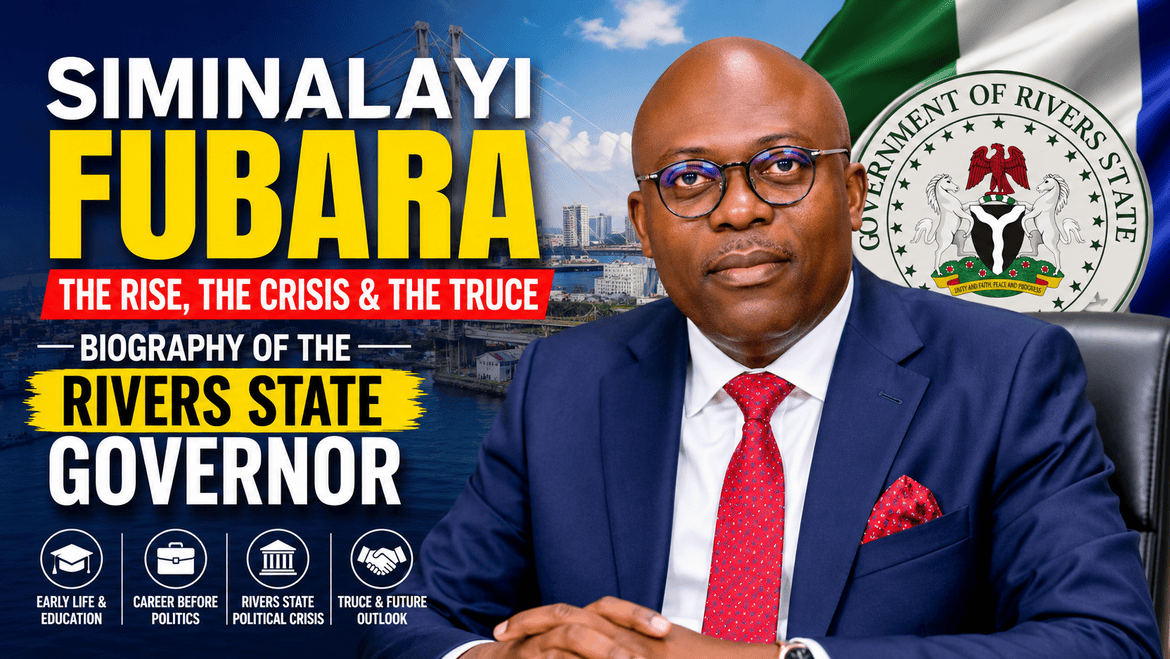
Siminalayi Fubara has become one of the most talked-about political figures in Nigeria over the past few years, not only because of his rapid rise from a civil service background to the governorship of Rivers State, but also due to the prolonged political standoff that has gripped the state since 2023. This article breaks down his early life, education, career journey, and the twists and turns of the Rivers State political crisis, presented in a clear and easy-to-follow format.
Read also:Alex Otti Biography: Early Life, Banking Career and Net Worth 2026
Who Is Siminalayi Fubara?
Siminalayi Fubara, full name Amaopusenibo Siminalayi Joseph Fubara, is a Nigerian politician and trained accountant who has served as the Governor of Rivers State since May 2023. Before entering elective politics, he built a long career within the Rivers State civil service, eventually rising to the position of Accountant General of the state. His journey from a classroom teacher to the state’s chief executive is often cited as a story of steady, methodical progress through the ranks of public administration rather than a typical politician’s path.
Siminalayi Fubara’s Age and Early Life
Fubara was born on January 28, 1975, in Opobo Town, located in the Opobo/Nkoro Local Government Area of Rivers State, Nigeria. In the Opobo-Ibani dialect, his first name translates roughly to “the poor may beget the rich,” a phrase that has taken on symbolic meaning given his rise to the state’s highest political office.
He is the second child and first son in a family of several children born to his late father, Joseph Fubara, a former soldier, and his late mother, Love Fubara, who worked as a civil servant. Fubara’s roots trace back to a well-known family in Opobo, and his upbringing in the coastal community shaped much of his early worldview and connection to Rivers State’s riverine communities.
Education
Fubara’s academic path began at Opobo Primary School, where he completed his First School Leaving Certificate in 1986. He proceeded to Comprehensive Secondary School in Opobo, obtaining his West African School Certificate in 1992. He later gained admission into what is now Rivers State University, where he studied for a first degree connected to business and accounting.
He did not stop there. Fubara went on to earn a postgraduate diploma in accounting from Enugu State University of Science and Technology, followed by a Master of Business Administration from the University of Port Harcourt Business School and a Master of Science degree in Finance. His academic credentials are complemented by professional fellowships, including recognition from the Nigerian Institute of Management and national accounting bodies, reflecting a career built firmly on financial and administrative expertise.
Career Before Politics
Fubara’s professional life started in 2003, when he was employed as a classroom teacher by the Rivers State Post-Primary Schools Board and posted to Comprehensive High School, Alesa-Eleme. After several years teaching, he transitioned into the finance sector in 2007, joining the Rivers State Ministry of Finance as a Senior Accountant.
From there, his rise through the civil service was steady rather than dramatic. He moved up through the roles of Principal Accountant, Chief Accountant, Assistant Director, and Deputy Director, before becoming Director of Finance and Accounts at the Rivers State Government House around 2015.
This background in public finance is frequently pointed to as one of the reasons he was considered a suitable, technocratic choice for the governorship when the opportunity arose.
Entry Into Politics and Governorship
Fubara’s move into elective politics came in 2022, when he emerged as the Peoples Democratic Party’s (PDP) candidate for the Rivers State governorship, with the backing of his predecessor, Nyesom Wike, who was then the sitting governor. He went on to win the March 2023 gubernatorial election and was sworn in as Governor of Rivers State on May 29, 2023.
What followed his inauguration, however, was not the smooth administration many expected, but rather one of the most closely watched political conflicts in recent Nigerian history.
The Rivers State Political Crisis Explained
The trouble between Governor Fubara and his political godfather, Nyesom Wike, who moved on to become the Minister of the Federal Capital Territory (FCT) under President Bola Tinubu, began just months after Fubara took office in 2023. At its core, the disagreement centered on control of Rivers State’s political structure and decision-making, with Wike allegedly expecting continued influence over appointments and governance even after leaving the governor’s seat.
The conflict escalated when a majority faction of the Rivers State House of Assembly, loyal to Wike, moved against Fubara, while a smaller group of lawmakers remained supportive of the governor. Tensions boiled over into real-world unrest, including an incident in which a section of the State Assembly complex was set ablaze, and reports of explosions linked to the political standoff in Port Harcourt.
President Tinubu stepped in as a mediator as early as October 2023, brokering a peace agreement at the Presidential Villa. That agreement required Fubara to recognize the Wike-aligned lawmakers who had defected to the All Progressives Congress (APC). However, the truce proved fragile, and disputes over budgets, legislative sessions, and allegations of intimidation persisted well into 2024.
The State of Emergency
Matters reached a boiling point in March 2025. Citing security concerns, including reports of pipeline vandalism that he said the state government had failed to contain, President Tinubu declared a six-month state of emergency in Rivers State on March 18, 2025. This suspended Governor Fubara, his deputy, Ngozi Nma Odu, and the entire State House of Assembly, and led to the appointment of a retired naval officer as an administrator to run the state in their absence.
The emergency rule lasted its full six months and officially ended on September 18, 2025, when President Tinubu reinstated Fubara, his deputy, and the lawmakers, citing improved dialogue and cooperation between the feuding parties.
Renewed Tensions and a Fresh Truce
Peace did not last long. By January 2026, Wike-aligned lawmakers launched a third attempt to impeach Fubara, accusing him of governance failures, including a delay in presenting the state’s annual budget. This prompted yet another round of presidential intervention, with President Tinubu meeting both Fubara and Wike at the Presidential Villa to press for a lasting resolution.
As part of the reconciliation efforts that followed, Fubara announced his defection from the PDP to the APC in December 2025, describing it as a gesture of alignment with President Tinubu. By mid-2026, Fubara had publicly declared that the political crisis was over, expressing support for President Tinubu’s re-election and endorsing a political coalition associated with Wike, while also naming a preferred successor ahead of the 2027 Rivers State governorship election.
While the state has since presented its long-delayed budget and returned to a more normal governance rhythm, the political relationship between Fubara and Wike’s camp remains one that many observers continue to watch closely given the state’s history of fragile truces.
Family and Personal Life
Fubara is known to be a family man, though he has generally kept details of his immediate family out of the public spotlight, focusing public attention instead on his administrative record and policy initiatives, including infrastructure projects such as road and healthcare developments across Rivers State.
Why This Story Matters
Rivers State is one of Nigeria’s most economically significant states due to its oil and gas resources, making political stability there a matter of national interest. Fubara’s story is a useful case study in Nigerian godfather politics, the practice where a political mentor expects continued control over a protégé after helping them into office, and how such dynamics can destabilize governance even after a peaceful transition of power.
Frequently Asked Questions (FAQs)
1. How old is Siminalayi Fubara? Siminalayi Fubara was born on January 28, 1975, in Opobo Town, Rivers State, Nigeria.
2. What was Siminalayi Fubara’s career before becoming governor? He worked in the Rivers State civil service, starting as a classroom teacher in 2003 before moving into public finance, where he rose through several ranks to become Accountant General of Rivers State in 2020.
3. When did Siminalayi Fubara become Governor of Rivers State? He was sworn in as Governor of Rivers State on May 29, 2023, after winning the March 2023 gubernatorial election.
4. What caused the Rivers State political crisis? The crisis stemmed from a power struggle between Governor Fubara and his predecessor, Nyesom Wike, over control of the state’s political structure, which led to a divided State House of Assembly, multiple impeachment attempts, and a period of federal emergency rule.
5. What happened during the Rivers State state of emergency? President Bola Tinubu declared a six-month state of emergency in Rivers State on March 18, 2025, suspending Governor Fubara, his deputy, and the entire State House of Assembly, and appointing an administrator to run the state until September 2025.
6. Is the Rivers State political crisis over? As of mid-2026, Governor Fubara has publicly stated that the crisis has ended, following his defection to the APC and renewed political alignment with Nyesom Wike’s camp, though the situation continues to be closely monitored.
7. Who is Siminalayi Fubara’s political godfather? Nyesom Wike, the former Governor of Rivers State and current Minister of the Federal Capital Territory, is widely regarded as the political figure who backed Fubara’s rise to the governorship.
8. What is Siminalayi Fubara’s educational background? He holds a first degree connected to accounting and business from Rivers State University, a postgraduate diploma in accounting from Enugu State University of Science and Technology, an MBA from the University of Port Harcourt Business School, and a Master of Science degree in Finance.