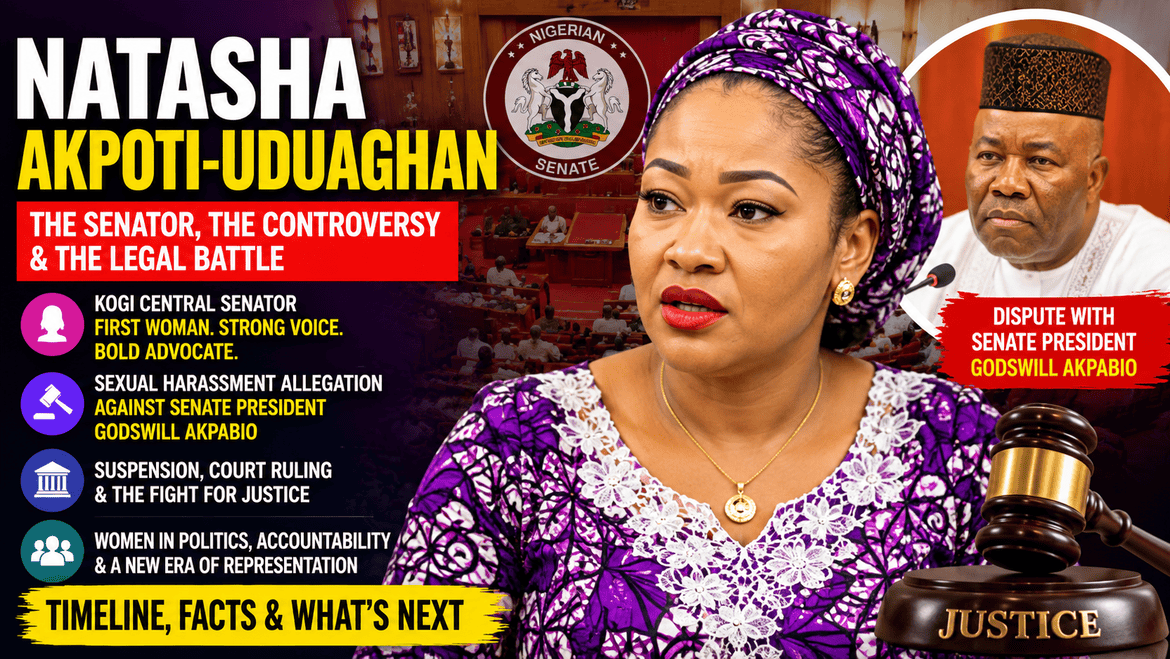
Natasha Akpoti-Uduaghan is one of the most recognizable names in Nigerian politics today, known both for breaking new ground as Kogi State’s first elected female senator and for a prolonged, highly publicized dispute with Senate President Godswill Akpabio that dominated national headlines for much of 2025 and into 2026. This article walks through her early life, education, professional background, and a clear, fact-based timeline of the Senate controversy that brought her international attention.
Read also:Siminalayi Fubara Biography: Age, Career and Rivers State Crisis Explained
Who Is Natasha Akpoti-Uduaghan?
Natasha Hadiza Akpoti-Uduaghan is a Nigerian lawyer, entrepreneur, and politician who represents the Kogi Central Senatorial District in Nigeria’s 10th National Assembly. Before her election to the Senate in 2023, she had already built a public profile as a legal practitioner and advocate.
Since taking her Senate seat, she has become known for outspoken advocacy on women’s representation in governance, industrial development, and institutional accountability, qualities that have made her both a popular figure among supporters and a lightning rod for controversy within the Senate leadership.
Natasha Akpoti-Uduaghan’s Age and Early Life
Natasha Akpoti-Uduaghan was born on December 9, 1979. Various sources place her birth either in Ilorin, Kwara State, or in the Okehi/Okene area of Kogi State, though she is widely identified as hailing from the Ebira ethnic group of Kogi Central. She is the second of four children born to a Nigerian father, a medical doctor from Kogi State, and a Ukrainian mother. Her parents reportedly met while her father was studying medicine abroad, giving Natasha a multicultural upbringing that she has said shaped her interest in governance and human rights from an early age.
She spent much of her childhood and early schooling in Kogi State before pursuing higher education.
Education
Natasha Akpoti-Uduaghan pursued legal studies at the university level, earning a Bachelor of Laws (LLB) degree before proceeding to the Nigerian Law School, where she qualified as a barrister and was called to the Nigerian Bar in the mid-2000s. Her legal training laid the foundation for her early professional career and later informed her approach to legislative work and public advocacy.
Career Before Politics
After qualifying as a lawyer, Akpoti-Uduaghan worked as legal counsel for Brass LNG, a liquefied natural gas company, from around 2007 to 2010, gaining experience in the corporate and energy sectors. In 2015, she founded the Builders Hub Impact Investment Program (BHIIP), an initiative focused on social and economic development, particularly around youth empowerment and community investment.
During this period, she also became a prominent public voice calling for the revival of the Ajaokuta Steel Company, a state-owned industrial project that has remained largely non-operational for decades despite billions of dollars invested in it. Her research, public lectures, and advocacy work around Ajaokuta earned her national recognition, including an award from the Nigerian Society of Engineers in December 2017.
Entry Into Politics
Akpoti-Uduaghan’s first attempt at elective office came in 2019, when she contested the Kogi State governorship election under the Social Democratic Party (SDP). She was unsuccessful, but the campaign raised her national profile considerably.
She returned to electoral politics in 2023, this time contesting the Kogi Central Senatorial District seat under the Peoples Democratic Party (PDP). Following a keenly contested election and a subsequent legal dispute over the result, the Court of Appeal in Abuja affirmed her as the duly elected senator, making her the first woman elected to represent Kogi Central in the National Assembly.
The Senate Controversy Explained
The dispute that would come to define much of Akpoti-Uduaghan’s Senate tenure began in February 2025. On February 20, a disagreement arose during a plenary session over her seating arrangement in the chamber, after she was reassigned away from her original seat. She also reported that she had earlier been moved from chairing the Senate Committee on Local Content to the Diaspora and Non-Governmental Organisations Committee, a change she viewed as a demotion linked to tensions with Senate leadership.
She submitted a petition on the Senate floor outlining her allegations. The Senate’s Committee on Ethics, Privileges, and Public Petitions reviewed the petition and dismissed it, citing procedural grounds, describing it as not properly brought before the chamber. Akpabio has consistently denied the harassment allegations.
The Suspension
Shortly after the harassment allegation became public, the Senate leadership moved against Akpoti-Uduaghan on separate disciplinary grounds. In March 2025, the Senate’s Ethics Committee recommended, and the chamber approved, a six-month suspension, citing violations of Senate Standing Rules, including allegedly speaking without recognition from the presiding officer and refusing to occupy her assigned seat. As part of the suspension, her salary and allowances were withheld, her security detail and office access were withdrawn, and she was barred from publicly identifying herself as a sitting senator.
The suspension drew sharp criticism from civil society organizations, including the Socio-Economic Rights and Accountability Project (SERAP), which argued that punishing a lawmaker for exercising her right to free expression was unconstitutional and disproportionate. SERAP formally petitioned the Senate President to reverse the suspension and later filed a lawsuit at the Federal High Court in Abuja seeking her reinstatement.
The Court Battles
Akpoti-Uduaghan challenged her suspension in court, arguing that it violated her right to a fair hearing and breached the Senate’s own standing orders. On July 4, 2025, Justice Binta Nyako of the Federal High Court in Abuja ruled that the suspension was excessive and unconstitutional, ordering her immediate reinstatement. In the same judgment, however, the court also found her in contempt over a satirical social media post directed at Akpabio, fining her five million naira.
Despite the court ruling, the Senate leadership initially resisted her return, arguing that it had not received a certified copy of the judgment and that the ruling did not carry a binding directive compelling her reinstatement. This led to weeks of standoff even after her six-month suspension period had technically lapsed in September 2025.
Eventually, on September 23, 2025, the Senate unsealed her office, and she formally resumed her legislative duties the following day, telling reporters she had no apology to offer for her conduct during the dispute.
The legal dispute did not end there. Senate President Akpabio appealed the Federal High Court ruling to the Court of Appeal and later escalated the matter to the Supreme Court in January 2026, arguing that the courts should not interfere in what he described as the Senate’s internal parliamentary affairs. As of mid-2026, aspects of the legal battle between both parties remained unresolved, and the underlying tension between Akpoti-Uduaghan and the Senate leadership has continued to surface periodically in the National Assembly.
Why This Controversy Matters
The standoff between Akpoti-Uduaghan and Senate leadership has raised important questions in Nigerian public discourse around legislative discipline, gender representation in politics, and the extent to which courts can review the internal disciplinary decisions of the National Assembly. As one of only a handful of women in the Nigerian Senate, her case has also been widely discussed in the context of the broader challenges facing women in Nigerian political life.
Personal Life
Akpoti-Uduaghan is married to a Delta State-based businessman and traditional title holder, and she has spoken publicly about balancing her advocacy work and legislative responsibilities with her family life. She remains active on social media, where she frequently engages directly with constituents and the wider public on political and social issues.
Frequently Asked Questions (FAQs)
1. How old is Natasha Akpoti-Uduaghan? Natasha Akpoti-Uduaghan was born on December 9, 1979.
2. What senatorial district does Natasha Akpoti-Uduaghan represent? She represents the Kogi Central Senatorial District in the Nigerian Senate, having been elected in 2023.
3. What is Natasha Akpoti-Uduaghan’s professional background? She is a trained lawyer who worked as legal counsel for Brass LNG before founding the Builders Hub Impact Investment Program in 2015 and becoming known for her advocacy to revive the Ajaokuta Steel Company.
4. What caused the Senate controversy involving Natasha Akpoti-Uduaghan? The dispute began with a seating arrangement disagreement in February 2025, after which she accused Senate President Godswill Akpabio of sexual harassment. The Senate subsequently suspended her for six months, citing separate violations of Senate rules and decorum.
5. Was Natasha Akpoti-Uduaghan’s suspension overturned? Yes. On July 4, 2025, the Federal High Court in Abuja ruled that her six-month suspension was excessive and unconstitutional and ordered her reinstatement, though she did not formally resume duties until September 2025 following further disputes over the ruling’s enforcement.
6. Did Godswill Akpabio respond to the harassment allegations? Yes, Senate President Godswill Akpabio has consistently denied the sexual harassment allegations made against him by Senator Akpoti-Uduaghan.
7. Is the legal dispute between Natasha Akpoti-Uduaghan and the Senate leadership over? Not entirely. Senate President Akpabio appealed the Federal High Court’s ruling and escalated the matter to the Supreme Court in January 2026, and aspects of the case remained unresolved as of mid-2026.
8. Was Natasha Akpoti-Uduaghan the first woman elected to represent Kogi Central? Yes, her 2023 election made her the first woman ever elected to represent the Kogi Central Senatorial District in Nigeria’s National Assembly.