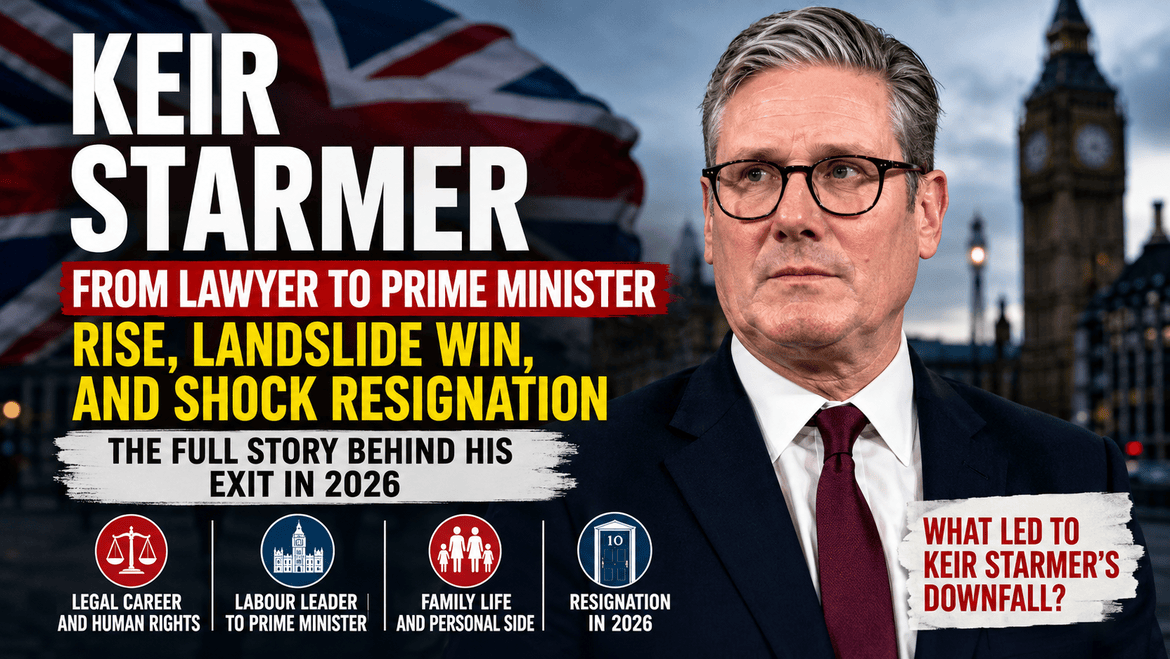
Sir Keir Starmer is one of the most consequential British political figures of the past decade. A former human rights lawyer who rose to become Director of Public Prosecutions before entering Parliament, Starmer led the Labour Party to a landslide election victory in 2024, only to step down from Downing Street less than two years later, in the summer of 2026. This article walks through his age and background, his legal and political career, his family life, and the circumstances surrounding his resignation.
Read also:Marco Rubio Biography: Age, Career, and His Role as Secretary of State (2026 Update)
Who Is Keir Starmer?
Keir Rodney Starmer was born on September 2, 1962, in Southwark, South East London, and was raised in the Surrey town of Oxted. He was one of four children born to Rodney Starmer, a toolmaker, and Josephine Starmer, a nurse. His parents were committed Labour supporters, and he was reportedly named after Keir Hardie, the first parliamentary leader of the Labour Party, a detail many biographers point to as an early sign of the political path he would eventually follow.
As of 2026, Keir Starmer is 63 years old.
He attended Reigate Grammar School, which shifted from a state school to a fee-paying independent institution partway through his time there. Starmer became the first person in his family to attend university, studying law at the University of Leeds, where he graduated with a first-class degree in 1985. He then pursued postgraduate legal studies at St Edmund Hall, Oxford, earning a Bachelor of Civil Law degree.
Early Legal Career
Starmer was called to the Bar in 1987 and built a long career as a barrister specializing in human rights and criminal law. He became a member, and later joint head, of Doughty Street Chambers, a London law firm known for its human rights work. During this period, he took on cases involving the abolition of the death penalty in parts of the Caribbean and Africa, and he was involved in the long-running “McLibel” case, one of the lengthiest trials in English legal history.
In 2002, Starmer was appointed Queen’s Counsel, a mark of distinction for senior barristers. Six years later, in 2008, he was appointed Director of Public Prosecutions (DPP) and head of the Crown Prosecution Service, a role he held until 2013. As DPP, Starmer oversaw prosecutorial policy on major and sensitive cases, a period that shaped his later public image as a methodical, detail-oriented figure rather than a natural showman.
Entry into Politics
Starmer entered frontline politics relatively late compared to many of his peers. He was elected to the House of Commons in 2015 as the Member of Parliament for Holborn and St Pancras. He quickly moved into shadow cabinet roles under Jeremy Corbyn’s leadership, most notably serving as Shadow Brexit Secretary, where he became one of the party’s most visible figures during the UK’s departure from the European Union.
Following Labour’s defeat in the 2019 general election and Corbyn’s resignation, Starmer announced his candidacy for the party leadership in January 2020. He won the contest that April with just over 56 percent of the vote, defeating rivals Rebecca Long-Bailey and Lisa Nandy, and became Leader of the Opposition.
As Labour leader, Starmer steered the party away from the more left-wing positions associated with the Corbyn era, pushing it toward the political center in an effort to rebuild trust with a broader electorate.
Becoming Prime Minister
After Prime Minister Rishi Sunak called an early general election, the country went to the polls on July 4, 2024. Labour won a sweeping majority, taking 410 of the 650 seats in the House of Commons, one of the largest parliamentary majorities in the party’s history. Starmer was appointed Prime Minister shortly afterward, ending fourteen years of Conservative-led government.
His premiership focused on stabilizing public finances, reforming the National Health Service, addressing immigration and border policy, and navigating foreign policy challenges including relations with the United States, NATO, the war in Ukraine, and the conflict in Gaza.
Personal Life
Keir Starmer married Victoria Starmer (née Alexander), a solicitor who later moved into occupational health work with the NHS, in 2007. The couple have two children, a son and a daughter, and have generally kept details about their children out of the public eye, choosing to raise them away from media attention. The family lives in North London.
Away from politics and law, Starmer has long been known for his devotion to football. He has supported Arsenal since childhood and has played in amateur leagues for years. As a teenager, he also took violin lessons alongside Norman Cook, who later became famous as the musician Fatboy Slim.
The 2026 Resignation
Despite the scale of Labour’s 2024 election win, Starmer’s time in Downing Street proved turbulent. Through late 2025 and into 2026, his government faced mounting criticism from multiple directions: concerns over immigration policy and tax increases from some quarters, and criticism over welfare reform, the Gaza conflict, and the absence of a wealth tax from others.
The pressure intensified in early 2026 amid a political scandal connected to the appointment of Peter Mandelson as the UK’s ambassador to the United States, given his past association with convicted sex offender Jeffrey Epstein. Senior Labour figures, including Scottish Labour leader Anas Sarwar, publicly called on Starmer to resign over the affair.
Matters worsened after the May 2026 local elections, in which Labour lost a large number of council seats, with the right-wing populist party Reform UK making major gains. In the weeks that followed, dozens of Labour MPs, reportedly more than 95, called for Starmer to resign or set out a departure timetable. Several government figures resigned in protest, including Health Secretary Wes Streeting and several junior ministers.
On June 22, 2026, Starmer confirmed he would step down as Prime Minister. In his announcement outside 10 Downing Street, he acknowledged that his own parliamentary party had lost confidence in his ability to lead Labour into the next general election, and he said he accepted that judgment. He indicated he had informed the King of his decision and asked Labour’s National Executive Committee to set out a timetable for a leadership contest, with the process expected to conclude before Parliament’s return from summer recess. Greater Manchester Mayor Andy Burnham, who had recently won the Makerfield by-election and returned to Parliament, was widely viewed as the frontrunner to succeed him.
Starmer’s departure made him the latest in a string of short-tenured UK prime ministers, continuing a pattern of political instability that had also affected the Conservative Party in the years before Labour’s 2024 win.
Frequently Asked Questions
How old is Keir Starmer? Keir Starmer was born on September 2, 1962, making him 63 years old as of 2026.
What was Keir Starmer’s career before politics? He worked as a human rights barrister for over two decades, co-founding Doughty Street Chambers, before serving as Director of Public Prosecutions from 2008 to 2013.
When did Keir Starmer become Prime Minister? He became Prime Minister in July 2024 after Labour won a landslide victory in the general election held on July 4, 2024.
Who is Keir Starmer’s wife? His wife is Victoria Starmer, a former solicitor who later worked in NHS occupational health. They married in 2007 and have two children together.
Why did Keir Starmer resign in 2026? Starmer resigned after months of internal Labour Party pressure, driven by a political scandal involving a former ambassadorial appointment, heavy losses in the May 2026 local elections, and a large number of Labour MPs publicly calling for him to step down.
Who replaced Keir Starmer as Prime Minister? Following his resignation announcement, Andy Burnham, the Greater Manchester Mayor, was widely seen as the leading candidate to succeed him through the Labour leadership contest.
Does Keir Starmer remain a Member of Parliament? Starmer’s resignation applied to his role as Prime Minister and, by extension, Labour leader; reporting at the time of his announcement focused on the leadership transition rather than any departure from Parliament itself.
What is Keir Starmer’s political legacy expected to be? Analysts have described his tenure as one marked by an initially strong electoral mandate followed by rapid erosion of party support, positioning his premiership as a case study in how quickly political capital can be lost amid scandal and policy disputes.