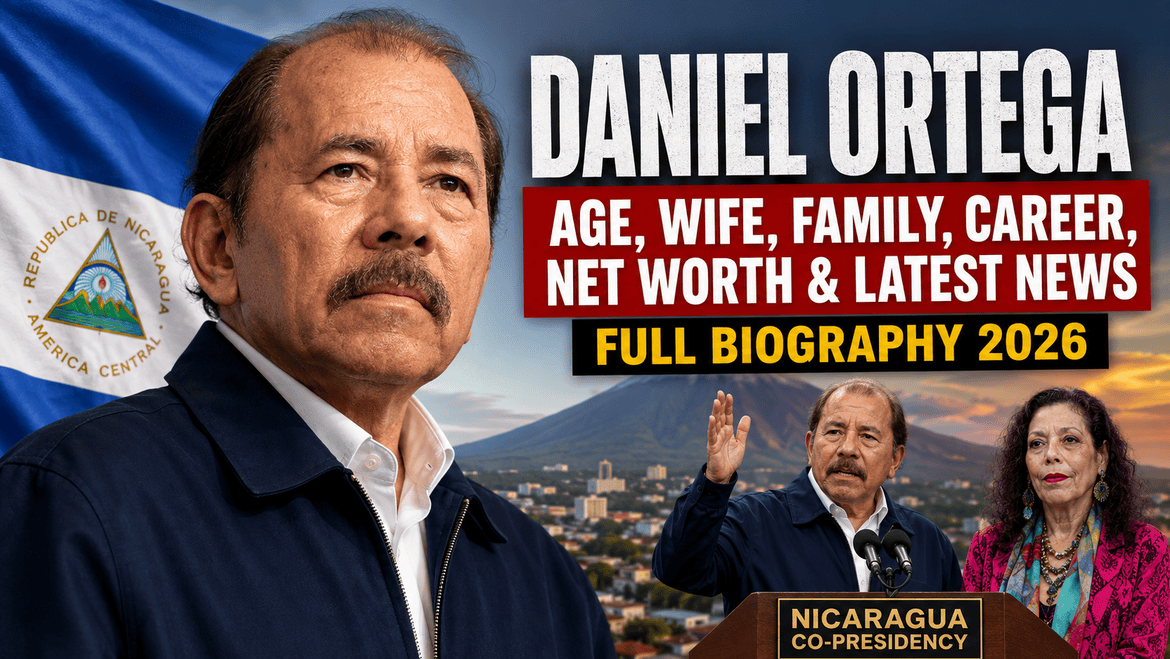
Daniel Ortega remains one of the most talked-about political figures in Latin America heading into 2026. As the long-serving leader of Nicaragua, his career spans revolutionary movements, multiple presidential terms, and, more recently, sweeping constitutional changes that have reshaped how the country is governed. This article breaks down everything currently known about his age, personal life, family, career milestones, estimated wealth, and the latest developments coming out of Managua.
Read also: Benjamin Netanyahu Biography: Age, Political Career and 2026 Trial Update
Who Is Daniel Ortega?
José Daniel Ortega Saavedra is a Nicaraguan politician and former guerrilla leader who rose to prominence during the Nicaraguan Revolution of the 1970s. He played a central role in the movement that toppled the Somoza family dictatorship in 1979, later becoming the face of the Sandinista National Liberation Front (FSLN), the socialist party that has dominated Nicaraguan politics for decades.
Ortega first governed the country as part of a revolutionary council before being formally elected president in 1985. After losing power in 1990, he spent years rebuilding his political base before returning to the presidency in 2007. Since then, he has remained in office continuously, making him one of the longest-serving heads of state in the Western Hemisphere.
Daniel Ortega’s Age and Early Life
Daniel Ortega was born on November 11, 1945, in La Libertad, in the department of Chontales, Nicaragua. That makes him 80 years old as of mid-2026, placing him among the oldest active heads of government in the world.
He grew up during a period of intense political unrest under the Somoza regime, an experience that shaped his early involvement in underground resistance movements. His brother, Humberto Ortega, was also a key military strategist within the FSLN and played a major role in the revolution before his passing in 2024.
Daniel Ortega’s Wife: Rosario Murillo
Ortega’s wife, Rosario Murillo, is arguably as influential in Nicaraguan politics as he is. Born on June 22, 1951, in Managua, Murillo has been married to Ortega since 1979, following earlier marriages. The couple has built one of the most tightly controlled political partnerships in the region.
Murillo’s political rise has been steady and significant. She served as Nicaragua’s vice president starting in 2017, and following constitutional reforms, she was elevated to the role of co-president alongside her husband in February 2025. This restructuring effectively formalized a dual-leadership arrangement, with Murillo now sharing executive authority rather than serving in a purely supportive capacity. Many analysts view her as central to the day-to-day running of the government and the country’s public messaging.
Family Life
Together, Ortega and Murillo have a large blended family, with several children from Murillo’s earlier relationships as well as children the couple share. Several family members hold visible roles in Nicaraguan media, business, or government-adjacent institutions, which critics argue reflects a broader concentration of power within the family circle. Ortega’s late brother, Humberto, remained a notable figure in Nicaraguan military history until his death in September 2024.
Career Timeline
- 1960s-1970s: Joined the FSLN as a young revolutionary and participated in underground resistance against the Somoza dictatorship.
- 1979: Became part of the Junta of National Reconstruction after the fall of the Somoza government.
- 1985-1990: Served as President of Nicaragua for the first time following formal elections.
- 1990: Lost the presidency in an electoral defeat, marking a major political setback.
- 2007: Returned to the presidency after rebuilding the FSLN’s political coalition.
- 2007-2025: Served continuously as president, winning multiple re-election contests that international observers frequently criticized as lacking transparency.
- 2017: Rosario Murillo joined the ticket as vice president.
- February 2025: Constitutional changes created a co-presidency, with Murillo formally sharing executive power.
- 2026: During celebrations marking the anniversary of the 1979 revolution, Ortega announced that Nicaragua would no longer hold elections, a move he justified by claiming foreign-backed opposition groups had used the electoral process to undermine his government. The announcement drew strong condemnation from opposition figures, human rights groups, and international observers, who described it as a further consolidation of authoritarian rule.
Throughout his time in office, Ortega’s government has faced sustained criticism from the United States, the European Union, and various human rights organizations over its treatment of political dissidents, restrictions on press freedom, and crackdowns on protest movements. Sanctions have been imposed on members of his administration in response to these actions.
Daniel Ortega’s Net Worth
Ortega’s exact net worth is difficult to verify, since financial disclosures from his administration are limited and much of his wealth is tied up in indirect business interests rather than public records. That said, various financial estimate outlets place his net worth in the range of $200 million as of 2026.
It’s worth noting that these figures are estimates based on publicly available reporting rather than confirmed financial statements, so they should be treated as approximate rather than definitive.
Latest News in 2026
The biggest headline surrounding Ortega in 2026 is his declaration that Nicaragua will stop holding elections altogether. Delivered during a speech commemorating the Sandinista Revolution’s anniversary, the announcement represents one of the most significant shifts in the country’s political structure in decades. Ortega has also made fewer public appearances recently, with a roughly two-month gap before his latest address, fueling speculation about his health and day-to-day involvement in governance. Despite this, he remains the country’s recognized head of state, governing jointly with Murillo.
Conclusion
Daniel Ortega’s story is one of a revolutionary-turned-statesman whose decades-long grip on Nicaraguan politics continues to draw global attention. From his early days fighting the Somoza dictatorship to his current co-presidency with wife Rosario Murillo, Ortega’s career reflects both the persistence and controversy that have defined modern Nicaraguan history. As 2026 unfolds, his recent decision to end elections is likely to remain a major point of international scrutiny.
Frequently Asked Questions (FAQs)
1. How old is Daniel Ortega in 2026? Daniel Ortega was born on November 11, 1945, making him 80 years old as of mid-2026.
2. Who is Daniel Ortega’s wife? His wife is Rosario Murillo, who currently serves as Nicaragua’s co-president alongside him. The couple has been married since 1979.
3. What is Daniel Ortega’s net worth? Estimates place his net worth at around $200 million as of 2026, though exact figures are difficult to confirm due to limited financial disclosures.
4. How long has Daniel Ortega been president of Nicaragua? He first served as president from 1985 to 1990, then returned to office in 2007 and has remained in power continuously since, making him one of the longest-serving heads of state in the region.
5. Is Daniel Ortega still president of Nicaragua? Yes. As of 2026, he continues to serve, now in a co-presidency arrangement with his wife, Rosario Murillo, following constitutional changes made in February 2025.
6. What did Daniel Ortega recently announce? In 2026, during celebrations marking the anniversary of the Sandinista Revolution, Ortega announced that Nicaragua would no longer hold elections, a decision that has drawn significant international criticism.
7. Does Daniel Ortega have children? Yes, he and Rosario Murillo have a large blended family, including children from Murillo’s previous relationships as well as children the couple share together.
8. What political party does Daniel Ortega lead? He leads the Sandinista National Liberation Front (FSLN), a socialist political party he has been associated with since the 1960s.