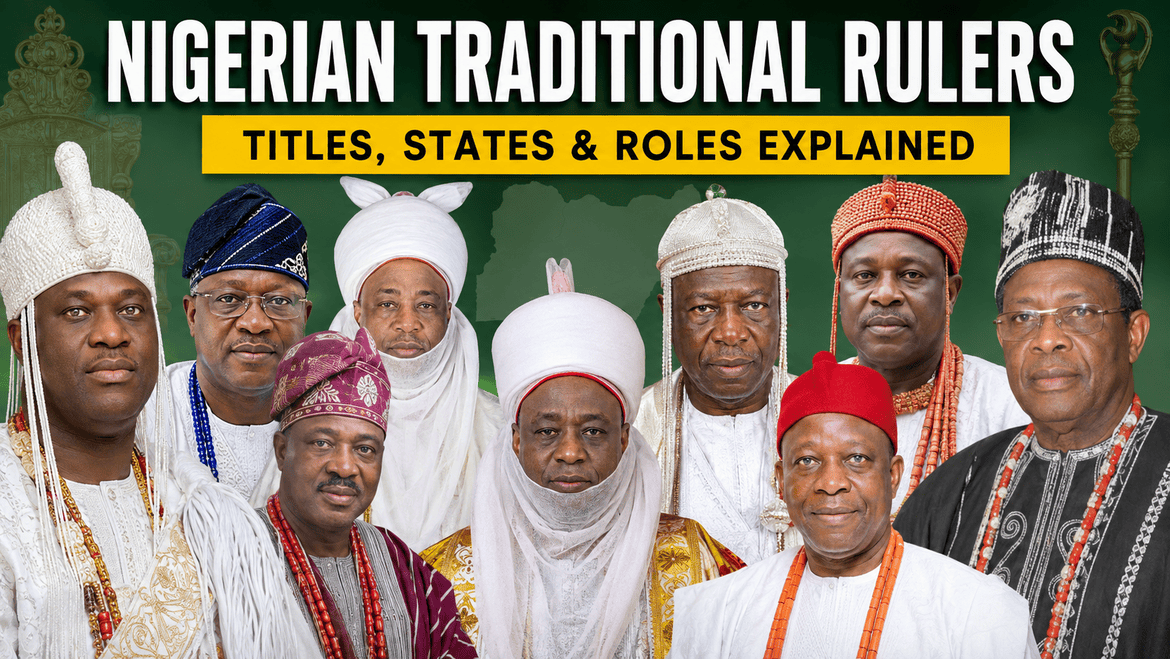
Nigeria is home to one of the richest traditional monarchy systems in Africa. Long before colonial administration and long after independence, traditional rulers have continued to serve as custodians of culture, mediators of peace, and symbols of identity for their people. While Nigeria today operates a democratic system of government, traditional rulers still command deep respect and influence across communities, and many state governments formally recognize them through Councils of Chiefs or Councils of Traditional Rulers.
This article breaks down who these traditional rulers are, the titles they hold, the states and regions they represent, and why their roles remain relevant in modern Nigeria.
Understanding the Traditional Ruler System in Nigeria
Nigeria does not have a single, uniform title for traditional rulers. Instead, titles vary by ethnic group, region, and kingdom. Broadly, they fall into a few major categories:
- Oba – used mainly among the Yoruba people of the South-West and by the Edo people of Benin Kingdom
- Igwe / Obi / Eze – common titles among Igbo communities in the South-East
- Chief / Amanyanabo / Pere – used by several ethnic nationalities in the South-South (Niger Delta)
- Etsu, Ohinoyi, Tor, Aku Uka, Osemawe and many other region-specific titles used across the Middle Belt and other parts of the country
Traditional rulers do not hold constitutional political power under Nigeria’s current 1999 Constitution, but state governments generally recognize a hierarchy of First Class, Second Class, and Third Class traditional rulers, with First Class stools carrying the most prestige and influence.
Notable Nigerian Traditional Rulers and Their States
Below is a snapshot of some of the most prominent traditional rulers in Nigeria and the states or regions they represent. Because succession to these stools can change, through passing, dethronement, or new appointment, always confirm current details with official state government or palace sources before citing this information formally.
| Traditional Ruler | Title | State / Region |
|---|---|---|
| Oba Adeyeye Enitan Ogunwusi (Ojaja II) | Ooni of Ife | Osun State |
| Oba Abimbola Akeem Owoade I | Alaafin of Oyo | Oyo State |
| Oba Rashidi Adewolu Ladoja | Olubadan of Ibadan | Oyo State |
| Oba Rilwan Akiolu I | Oba of Lagos | Lagos State |
| Oba Ewuare II | Oba of Benin | Edo State |
| Muhammadu Sanusi II | Emir of Kano | Kano State |
| Muhammadu Sa’ad Abubakar III | Sultan of Sokoto | Sokoto State |
| Igwe Nnaemeka Alfred Achebe | Obi of Onitsha | Anambra State |
| Professor James Ayatse | Tor Tiv | Benue State |
| Benjamin Ikenchuku Keagborekuzi I | Dein of Agbor | Delta State |
This is only a snapshot of a few widely recognized stools. Nigeria has dozens of additional traditional rulers of note across states such as Rivers, Cross River, Akwa Ibom, Kwara, Niger, Kogi, Plateau, Nasarawa, Ebonyi, Enugu, Imo, Abia, Ogun, Ekiti and more
Why Traditional Rulers Still Matter in Modern Nigeria
Even without formal political authority, traditional rulers continue to play important roles, including:
1. Cultural preservation. They serve as custodians of language, festivals, rites of passage, and indigenous knowledge systems that might otherwise fade with modernization.
2. Conflict resolution. Many communities still bring land disputes, chieftaincy disagreements, and family conflicts to traditional rulers before, or instead of, going through formal courts.
3. Community mobilization. Traditional rulers are often called upon by governments and NGOs to support public health campaigns, security initiatives, and development projects because of the trust they command locally.
4. Symbol of unity. In a country as ethnically diverse as Nigeria, traditional institutions help preserve a sense of identity and continuity for their people, connecting present generations to centuries of history.
5. Advisory influence. State governments frequently consult first-class traditional rulers on matters affecting their domains, even though such consultation is informal rather than constitutional.
How Succession Works
Succession practices differ significantly from one kingdom to another:
- In many Yoruba kingdoms, the stool typically rotates among recognized ruling houses, with kingmakers responsible for selecting a new Oba from eligible candidates.
- Emirate stools in the North are usually filled through appointment by the state governor, guided by recommendations from the emirate’s kingmakers and ruling families.
- In several Igbo communities, some royal stools use hereditary succession, while others, such as the Obi of Onitsha, involve the ruler “emerging” through a defined selection process rather than a formal coronation.
- The Olubadan of Ibadan follows a unique rotational system between two ruling lines (the Olubadan/Civil line and the Balogun/Military line), a structure distinct from most other Yoruba monarchies.
Because succession disputes occasionally arise, sometimes resulting in more than one claimant to a stool, as has happened historically with a few emirate titles, it is always best to verify a ruler’s current status through recent, credible news sources.
Conclusion
Nigeria’s traditional rulers remain a vital thread connecting the country’s past to its present. From the Ooni of Ife in Osun State to the Sultan of Sokoto in Sokoto State, these monarchs continue to shape community life, culture, and even indirect governance across the federation. Whether you are researching Nigerian culture for academic purposes, journalism, tourism, or personal interest, understanding this list of traditional rulers and their states offers valuable insight into how deeply tradition still shapes modern Nigerian society.
Frequently Asked Questions (FAQs)
1. Who is the most powerful traditional ruler in Nigeria? There is no official ranking of “most powerful” traditional ruler, since Nigeria does not have a single national monarch. However, stools such as the Sultan of Sokoto, the Ooni of Ife, the Oba of Benin, and the Alaafin of Oyo are widely regarded as among the most historically significant and influential due to their large followings and long-standing dynasties.
2. Do traditional rulers have political power in Nigeria? No. Under Nigeria’s current constitution, traditional rulers do not hold formal political or legislative power. Their influence is cultural, social, and advisory rather than constitutional. State governments, however, often maintain Councils of Chiefs or Traditional Rulers to formally engage them on local matters.
3. How are traditional rulers selected in Nigeria? Selection processes vary by kingdom. Some use rotational systems among ruling houses, some rely on hereditary succession within a single royal family, and others involve appointment by a state governor based on recommendations from kingmakers or emirate councils.
4. Are traditional rulers paid a salary by the government? In many states, traditional rulers receive stipends, allowances, or state-funded upkeep, particularly First Class rulers, since their roles are recognized under state chieftaincy laws. The exact structure varies from state to state.
5. Can a traditional ruler be removed from their throne? Yes. In several states, state governments retain the legal authority to depose a traditional ruler under specific circumstances, and there have been notable cases of dethronement and reinstatement in Nigeria’s traditional institutions in recent years.
6. What is the difference between an Oba, an Emir, and an Igwe? These are simply different regional and ethnic titles for a traditional ruler. “Oba” is used mainly in Yoruba and Benin kingdoms, “Emir” is used in most Hausa-Fulani emirates in Northern Nigeria, and “Igwe” (along with “Obi” and “Eze”) is common among Igbo communities in South-East Nigeria.
7. Why do some Nigerian states have more than one prominent traditional ruler? Nigeria’s traditional institutions predate its current state boundaries. Many states contain multiple historic kingdoms or emirates, each with its own traditional ruler, which is why a single state can have several recognized First, Second, or Third Class traditional rulers.