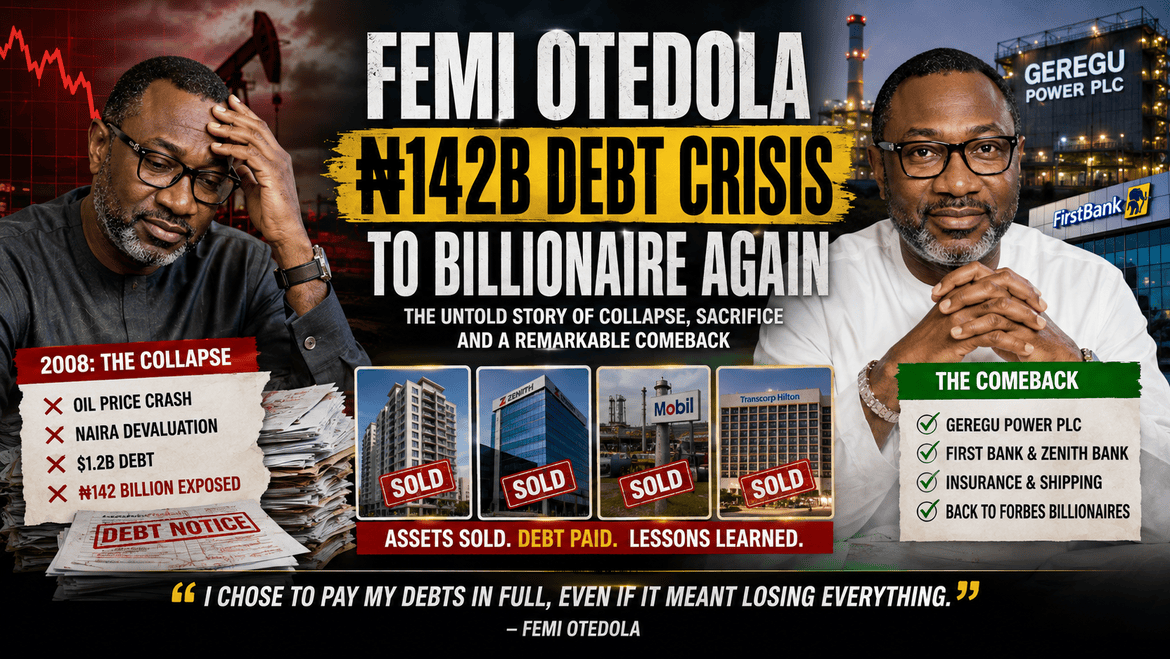
Long before he was known for his stakes in Geregu Power and Nigeria’s banking sector, Femi Otedola faced a financial collapse that nearly ended his business career entirely. In recent interviews and in his 2025 memoir, Making It Big, the Nigerian billionaire has revisited one of the darkest chapters of his life: a debt crisis that, at the exchange rate of the time, amounted to roughly ₦142 billion. This article walks through what happened, how the crisis unfolded, and how Otedola eventually rebuilt his fortune.
Read also: Femi Otedola Biography 2026: Net Worth & Business Empire
How the Crisis Began
The roots of Otedola’s debt crisis trace back to 2008, a year that brought together three separate shocks that hit his business empire almost simultaneously. At the time, his company Zenon Petroleum and Gas controlled a dominant share of Nigeria’s diesel market. Otedola has said he held roughly 93 percent of the diesel market at his peak, with a shipment of about one million tons of diesel en route to Nigeria when disaster struck.
Global oil prices collapsed that year, falling from around $146 a barrel to roughly $34. Since Otedola had ordered his diesel supply when prices were near their peak, the cargo arriving on the high seas was suddenly worth a fraction of what he had paid for it. He has described the moment vividly, recalling that he believed his business was finished the instant he understood what the price crash meant for the shipment already at sea.
As if the commodity crash wasn’t enough, Nigeria’s currency also devalued sharply during the same period, falling from around ₦120 per dollar to about ₦167 per dollar. Because much of his borrowing was denominated in dollars, the devaluation instantly inflated the naira value of his outstanding loans. On top of that, accruing interest payments and a sudden crash in Nigerian bank stocks, in which Otedola held major positions, compounded the damage further.
The Scale of the Debt
By the time the full impact of these shocks became clear, Otedola’s total exposure reached approximately $1.2 billion, a figure he has broken down in detail in his memoir: around $480 million lost to the oil price crash, $258 million to the naira’s devaluation, $320 million in accumulated interest, and a further $160 million wiped out by the stock market crash.
At the exchange rate prevailing during that period, this exposure translated to roughly ₦142 billion, though Otedola has also referenced a total debt figure of around ₦220 billion at a later stage, once additional obligations and accrued interest were factored in. He has described telling associates at the time that he was carrying a debt of ₦220 billion “around his neck,” a moment he says left him in tears once his guests had left his home.
The impact on his personal life and public image was severe. Otedola has recalled being besieged by debt collectors at his Lagos residence, describing large, intimidating men sent by banks to press him for repayment, a stark contrast to the years when the same institutions had courted him for his deposits. He has been candid about how close the pressure pushed him to despair, saying he weighed his options during the darkest period of the crisis before ultimately choosing to face the situation head-on rather than give up.
Rebuilding After the Collapse
Rather than accept a restructuring arrangement that would have spread his debt over a longer period, Otedola chose a different path. He has said he specifically rejected restructuring in favor of paying off his obligations outright, even if it meant giving up nearly everything he owned at the time.
To settle his debts, Otedola surrendered a significant portion of his assets. This included 184 residential flats, major shareholdings in Nigerian banks, and stakes in companies such as Africa Finance Corporation, Transcorp Hilton, Mobil, Texaco, and Visafone. By the end of the process, he was left with only a handful of possessions: his home in Ikoyi, a property in Abuja, his office on Walter Carrington Crescent in Lagos, and a 37 percent stake in African Petroleum.
The Nigerian government later established the Asset Management Corporation of Nigeria (AMCON) to absorb distressed loans from banks following the broader financial crisis. Otedola has said his creditor banks eventually sold his outstanding debt to AMCON for roughly $800 million, a “haircut” he attributed to what he called their own carelessness and greed during the lending boom years leading up to the crash.
From Debt to a Rebuilt Fortune
Otedola’s recovery centered on a strategic pivot away from oil marketing and toward power generation. His investment in Geregu Power PLC, where he currently serves as Executive Chairman, became a central pillar of his rebuilt business empire. Over time, he brought in institutional investors, including the Nigerian government and international partners, while retaining majority ownership of the company.
By the mid-2010s, Otedola had returned to Forbes’ global billionaire rankings, a marked turnaround from the depths of his 2008-2009 crisis. He has also expanded into banking, holding significant stakes in major Nigerian financial institutions, and has continued to diversify his holdings across sectors including insurance and shipping.
Otedola has framed the experience as a formative one, describing the discipline and humility he says he gained through the collapse as lessons he could not have learned any other way. He has also connected the crisis to his later philanthropic commitments, saying a promise he made during his lowest point helped shape his subsequent giving toward humanitarian and educational causes in Nigeria.
Conclusion
Femi Otedola’s ₦142 billion debt ordeal stands as one of the most dramatic financial collapses in recent Nigerian business history, and one of the clearest examples of a full recovery from it. What began as a combination of a global oil price crash, a currency devaluation, and a stock market downturn nearly wiped out everything he had built. Yet by choosing to pay off his debts outright rather than restructure them, and by redirecting his focus toward power generation and banking, Otedola rebuilt a fortune that has kept him among Nigeria’s wealthiest individuals in the years since.
Frequently Asked Questions
1. How much debt did Femi Otedola owe during his crisis? His total exposure reached approximately $1.2 billion, which he has said was equivalent to around ₦142 billion at the exchange rate of the time, with some accounts citing a later total closer to ₦220 billion.
2. What caused Femi Otedola’s debt crisis? A combination of the 2008 global oil price crash, the devaluation of the Nigerian naira, rising interest payments, and a crash in Nigerian bank stocks combined to push his debt to crisis levels.
3. Did Femi Otedola restructure his debt? No. He has said he specifically declined a restructuring arrangement and chose instead to pay off his debts outright, even though it meant surrendering most of his assets.
4. What assets did Femi Otedola give up during the crisis? He surrendered 184 residential flats, major bank shareholdings, and stakes in companies including Africa Finance Corporation, Transcorp Hilton, Mobil, Texaco, and Visafone.
5. What role did AMCON play in his debt resolution? The Asset Management Corporation of Nigeria (AMCON) purchased his outstanding debt from creditor banks for approximately $800 million as part of a broader effort to absorb distressed bank loans.
6. How did Femi Otedola rebuild his fortune? He redirected his focus toward power generation through Geregu Power PLC and later expanded into banking, gradually rebuilding his wealth and returning to global billionaire rankings by the mid-2010s.
7. Where did Femi Otedola share the details of his debt crisis? He detailed the experience extensively in his 2025 memoir, Making It Big: Lessons from a Life in Business, and has discussed it in various interviews since its release.